 Poster Archive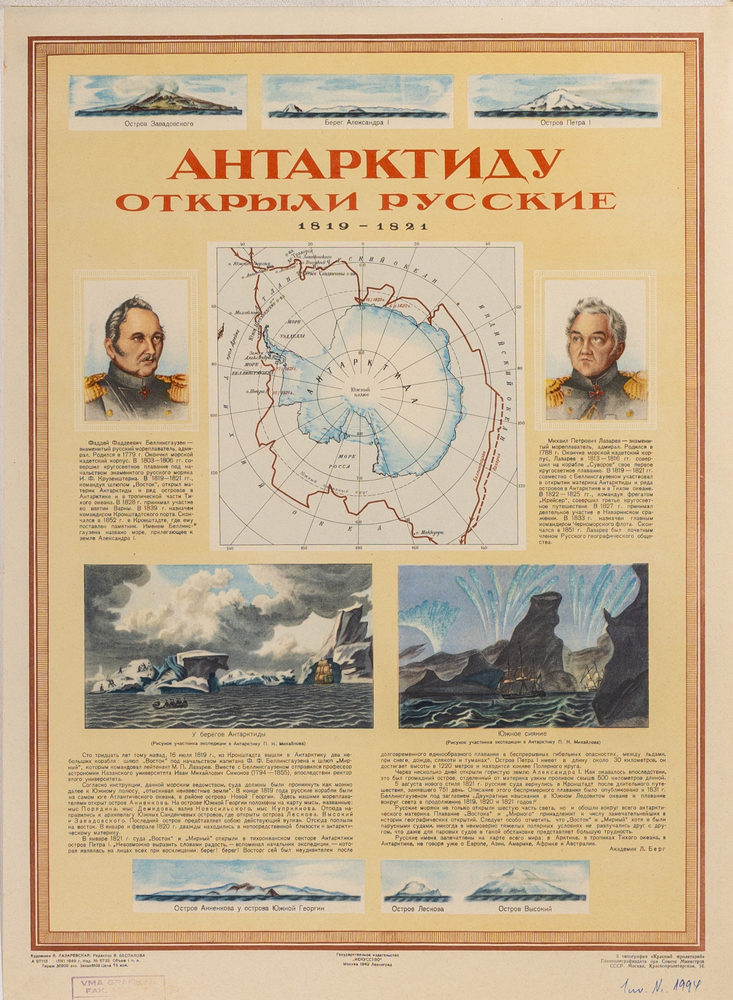
Antarctica was discovered by Russians (1819 – 1824) (Russian lang.)
Poster
This image is available only to signed-in users.
Protected by copyright. The poster images are published on the website for non-commercial purposes – for viewing, education and research.
- Identifier
- JS608
- Category
- P.10. Miscellaneous
- Subject
- P.10. Miscellaneous
- Shelve
- E.5.
- Title
-
en
Antarctica was discovered by Russians (1819 – 1824) (Russian lang.)
AI (Unreviewed)
Provenance Translated by mistral-large-latest on 23.04.2026 - Antarktīdu atklāja krievi (1819 – 1824) (krievu val.)
- Year
- 1949
- Author
- V. Vazerevskaja
- Publisher
- Izdevniecība “Isskustvo“
- Place
- Moscow
- Leningrad
- Method
- unknown
- Dimensions
- 42 x 57 cm
- Preservation
- 10
- Print run
- 30,000
- Count
- 2
- Language
-
Russian
AI (Unreviewed)
Provenance Generated by mistral-large-latest on 23.07.2026
The poster is designed on a light, sand-yellow background with a darker, brown border around it. At the top, a headline is written in large, red letters, beneath which the years are indicated in smaller black letters. In the center of the poster, there is a map of Antarctica with waters marked in blue and travel routes in red lines. On both sides of the map, two men's portraits are depicted in uniforms with gold details and medals. In the upper part, three blue illustrations show ships in icy waters. In the lower part, four black-and-white paintings depict ships and icy landscapes, as well as three small blue illustrations with island contours. At the bottom of the poster, there are text blocks with smaller, black letters. Various font sizes and weights are used throughout the poster.
AI (Unreviewed)
Provenance Generated by mistral-large-latest on 21.07.2026; Translated by mistral-large-latest on 22.07.2026
Остров. Звездовского
Берег. Александра I
Остров. Петра I
АНТАРКТИДУ
ОТКРЫДИ РУССКИЕ
1819 — 1821
[?] Фаддеевич. Беглинсгаузен — знаменитый русский мореплаватель, адмирал. Родился в 1779 г. [?] морской кадетской корпус. В 1803—1806 гг. совершил кругосветное плавание под начальством знаменитого русского мореха И. Ф. [?] В 1819—1821 гг., командуя [?] «Восток», открыл материк Антарктиды и ряд островов в Антарктике и в тропической части Тихого океана. В 1826 г. принимал участие во [?] Ворны. В 1839 г. [?] командиром Кронштадтского порта. Скончался в 1852 г. в Кронштадте, где ему поставлен памятник. [?] Беглинсгаузена названа [?] прилегающая к земле Александра I.
Михаил Петрович Лазарев — знаменитый мореплаватель, адмирал. Родился в [?] г. [?] морской кадетской корпус. Лазарев в 1813—1816 гг. совершил на корабле «Суворов» свое [?] кругосветное плавание. В 1819—1822 гг. совместно с Беглинсгаузеном участвовал в открытии материка Антарктиды и ряда островов в Антарктике и в Тихом океане. В 1822—1825 гг., командуя фрегатом [?] совершил [?] кругосветное путешествие. В 1827 г. принимал деятельное участие в [?] сражении. В 1833 г. назначен [?] командиром Черноморского флота. Скончался в 1851 г. Лазарев был почетным членом Русского географического общества.
У берегов Антарктиды
(Рисунок участника экспедиции в Антарктику П. Н. Михайлова)
Южное сияние
(Рисунок участника экспедиции в Антарктику П. Н. Михайлова)
Сто придать лет тому назад, 16 июля 1819 г., из Кронштадта вышли в Антарктику два небольших корабля — шлют «Восток» под начальством капитана Ф. Ф. Беглинсгаузена и шлют «Мирный», которым командовал лейтенант М. П. Лазарев. Вместе с Беглинсгаузеном отправился профессор астрономии Казанского университета Иван Михайлович Симонов (1794—1855), впоследствии ректор этого университета.
Согласно инструкции, данной морским ведомством, суда должны были проникнуть как можно далее к Южному полюсу, [?] неизвестные земли». В конце 1819 года русские корабли были на самом юге Атлантического океана, а районе острова Тихой Георгия. Здесь нашими мореплавателями открыт остров [?] На острове Южной Георгия половины на карту мыса, названные: мыс Порядина, мыс Демидова, [?] Новосильского, мыс Куприянова. Отсюда направлялся к [?] Южным [?] островам, где открыты острова Лескова, Высокий и Звездовского. Последний остров представляет собою действующий вулкан. Отсюда поплыли на восток. В январе и феврале 1820 г. дважды находились в непосредственной близости к антарктическому материку.
В январе 1821 г. суда «Восток» и «Мирный» открыли в тихоокеанском секторе Антарктики остров Петра I. «Невозможно выразить [?] радость — вспоминал начальник экспедиции — которая являлась на лицах всех при восклицании [?] берег! Восторг сей [?] неудивителен после
долговременного единообразного плавания в беспрерывных обильных опасностях, между льдами, при снеге, дожде, [?] и гужинах». Остров Петра I имеет в длину около 30 километров, он достигает высоты в [?] метров и находится [?] Полярного круга.
Через несколько дней открыли гористую землю Александра I. Как оказалось, впоследствии, это был громадный остров, отделенный от материка узким проливом свыше 500 километров длиной.
[?] августа нового [?] 1821 г. русские суда вернулись в Кронштадт после длительного путешествия, занявшего 751 день. Описание этого беспримерного плавания было опубликовано в [?] г. Беглинсгаузеном под заглавием [?] [?] в Южном Ледовитом океане и плавание вокруг света в продолжение 1819, 1820 и 1821 годов!
Русские моряки не только открыли шестую часть света, но и обошли вокруг всего антарктического материка. Плавание «Востока» и «Морного» принадлежит к числу замечательнейших в истории географических открытий. Следует особо отметить, что «Восток» и «Мирный» хотя и были парусными судами, никогда в [?] тяжелых полярных условиях не разлучались друг с другом, что даже для паровых судов в такой обстановке представляет большую трудность.
Русские [?] запечатлены на карте всего мира: в Арктике, в [?] Тихого океана, в Антарктике, на говоре уже о Европе, Азии, Америке, Африке и Австралии.
Академик Л. Берг
Остров Анненкова у острова Южной Георгия
Остров Лескова
Остров Высокий
[?] В. [?]
[?] [?] — [?] г. [?] № [?] Объем 1 п. л.
Тираж [?] экз. Заказ [?]
Государственная [?]
Москва [?] [?]
СССР. Москва, [?] [?]
VMA [?]
FAX
[?] [?] №. 1994
Берег. Александра I
Остров. Петра I
АНТАРКТИДУ
ОТКРЫДИ РУССКИЕ
1819 — 1821
[?] Фаддеевич. Беглинсгаузен — знаменитый русский мореплаватель, адмирал. Родился в 1779 г. [?] морской кадетской корпус. В 1803—1806 гг. совершил кругосветное плавание под начальством знаменитого русского мореха И. Ф. [?] В 1819—1821 гг., командуя [?] «Восток», открыл материк Антарктиды и ряд островов в Антарктике и в тропической части Тихого океана. В 1826 г. принимал участие во [?] Ворны. В 1839 г. [?] командиром Кронштадтского порта. Скончался в 1852 г. в Кронштадте, где ему поставлен памятник. [?] Беглинсгаузена названа [?] прилегающая к земле Александра I.
Михаил Петрович Лазарев — знаменитый мореплаватель, адмирал. Родился в [?] г. [?] морской кадетской корпус. Лазарев в 1813—1816 гг. совершил на корабле «Суворов» свое [?] кругосветное плавание. В 1819—1822 гг. совместно с Беглинсгаузеном участвовал в открытии материка Антарктиды и ряда островов в Антарктике и в Тихом океане. В 1822—1825 гг., командуя фрегатом [?] совершил [?] кругосветное путешествие. В 1827 г. принимал деятельное участие в [?] сражении. В 1833 г. назначен [?] командиром Черноморского флота. Скончался в 1851 г. Лазарев был почетным членом Русского географического общества.
У берегов Антарктиды
(Рисунок участника экспедиции в Антарктику П. Н. Михайлова)
Южное сияние
(Рисунок участника экспедиции в Антарктику П. Н. Михайлова)
Сто придать лет тому назад, 16 июля 1819 г., из Кронштадта вышли в Антарктику два небольших корабля — шлют «Восток» под начальством капитана Ф. Ф. Беглинсгаузена и шлют «Мирный», которым командовал лейтенант М. П. Лазарев. Вместе с Беглинсгаузеном отправился профессор астрономии Казанского университета Иван Михайлович Симонов (1794—1855), впоследствии ректор этого университета.
Согласно инструкции, данной морским ведомством, суда должны были проникнуть как можно далее к Южному полюсу, [?] неизвестные земли». В конце 1819 года русские корабли были на самом юге Атлантического океана, а районе острова Тихой Георгия. Здесь нашими мореплавателями открыт остров [?] На острове Южной Георгия половины на карту мыса, названные: мыс Порядина, мыс Демидова, [?] Новосильского, мыс Куприянова. Отсюда направлялся к [?] Южным [?] островам, где открыты острова Лескова, Высокий и Звездовского. Последний остров представляет собою действующий вулкан. Отсюда поплыли на восток. В январе и феврале 1820 г. дважды находились в непосредственной близости к антарктическому материку.
В январе 1821 г. суда «Восток» и «Мирный» открыли в тихоокеанском секторе Антарктики остров Петра I. «Невозможно выразить [?] радость — вспоминал начальник экспедиции — которая являлась на лицах всех при восклицании [?] берег! Восторг сей [?] неудивителен после
долговременного единообразного плавания в беспрерывных обильных опасностях, между льдами, при снеге, дожде, [?] и гужинах». Остров Петра I имеет в длину около 30 километров, он достигает высоты в [?] метров и находится [?] Полярного круга.
Через несколько дней открыли гористую землю Александра I. Как оказалось, впоследствии, это был громадный остров, отделенный от материка узким проливом свыше 500 километров длиной.
[?] августа нового [?] 1821 г. русские суда вернулись в Кронштадт после длительного путешествия, занявшего 751 день. Описание этого беспримерного плавания было опубликовано в [?] г. Беглинсгаузеном под заглавием [?] [?] в Южном Ледовитом океане и плавание вокруг света в продолжение 1819, 1820 и 1821 годов!
Русские моряки не только открыли шестую часть света, но и обошли вокруг всего антарктического материка. Плавание «Востока» и «Морного» принадлежит к числу замечательнейших в истории географических открытий. Следует особо отметить, что «Восток» и «Мирный» хотя и были парусными судами, никогда в [?] тяжелых полярных условиях не разлучались друг с другом, что даже для паровых судов в такой обстановке представляет большую трудность.
Русские [?] запечатлены на карте всего мира: в Арктике, в [?] Тихого океана, в Антарктике, на говоре уже о Европе, Азии, Америке, Африке и Австралии.
Академик Л. Берг
Остров Анненкова у острова Южной Георгия
Остров Лескова
Остров Высокий
[?] В. [?]
[?] [?] — [?] г. [?] № [?] Объем 1 п. л.
Тираж [?] экз. Заказ [?]
Государственная [?]
Москва [?] [?]
СССР. Москва, [?] [?]
VMA [?]
FAX
[?] [?] №. 1994
AI (Unreviewed)
Provenance Generated by mistral-ocr-latest on 23.07.2026
Zavadovsky Island
Coast of Alexander I
Peter I Island
ANTARCTICA
DISCOVERED BY THE RUSSIANS
1819 — 1821
[?] Faddeyevich Bellingshausen — a famous Russian navigator, admiral. Born in 1779. [?] Naval Cadet Corps. In 1803—1806, he made a circumnavigation under the command of the famous Russian navigator I. F. [?]. In 1819—1821, commanding the sloop [?] "Vostok," he discovered the continent of Antarctica and a number of islands in the Antarctic and the tropical part of the Pacific Ocean. In 1826, he took part in the [?] of Varna. In 1839, [?] commander of the Kronstadt port. He died in 1852 in Kronstadt, where a monument was erected to him. The sea adjacent to Alexander I Land is named after Bellingshausen.
Mikhail Petrovich Lazarev — a famous navigator, admiral. Born in [?]. [?] Naval Cadet Corps. In 1813—1816, Lazarev made his [?] circumnavigation on the ship "Suvorov." In 1819—1822, together with Bellingshausen, he participated in the discovery of the continent of Antarctica and a number of islands in the Antarctic and the Pacific Ocean. In 1822—1825, commanding the frigate [?], he made [?] a circumnavigation. In 1827, he took an active part in the [?] battle. In 1833, he was appointed [?] commander of the Black Sea Fleet. He died in 1851. Lazarev was an honorary member of the Russian Geographical Society.
Off the coast of Antarctica
(Drawing by participant of the Antarctic expedition P. N. Mikhailov)
Southern Lights
(Drawing by participant of the Antarctic expedition P. N. Mikhailov)
One hundred and some years ago, on July 16, 1819, two small ships set out from Kronstadt for the Antarctic — the sloop "Vostok" under the command of Captain F. F. Bellingshausen and the sloop "Mirny," commanded by Lieutenant M. P. Lazarev. Accompanying Bellingshausen was Professor of Astronomy at Kazan University, Ivan Mikhailovich Simonov (1794—1855), later rector of that university.
According to the instructions given by the naval department, the ships were to penetrate as far as possible towards the South Pole, [?] "unknown lands." At the end of 1819, the Russian ships were in the far south of the Atlantic Ocean, in the region of South Georgia Island. Here, our navigators discovered the island [?]. On South Georgia Island, they mapped capes named: Cape Poryadina, Cape Demidov, [?] Novosilsky, Cape Kupriyanov. From here, they headed towards the [?] Southern [?] Islands, where they discovered Leskov Island, Vysoky Island, and Zavadovsky Island. The latter is an active volcano. From here, they sailed east. In January and February 1820, they were twice in the immediate vicinity of the Antarctic continent.
In January 1821, the ships "Vostok" and "Mirny" discovered Peter I Island in the Pacific sector of the Antarctic. "It is impossible to express [?] the joy — recalled the expedition leader — that appeared on the faces of all at the exclamation [?] 'Land!' This delight [?] is not surprising after a long monotonous voyage amid continuous abundant dangers, among ice, in snow, rain, [?] and fog." Peter I Island is about 30 kilometers long, reaches a height of [?] meters, and is located [?] the Antarctic Circle.
A few days later, they discovered the mountainous land of Alexander I. As it turned out later, this was a huge island separated from the continent by a narrow strait over 500 kilometers long.
[?] August of the new [?] 1821, the Russian ships returned to Kronstadt after a long journey that lasted 751 days. The account of this unprecedented voyage was published in [?] by Bellingshausen under the title [?] [?] "In the Southern Icy Ocean and a Voyage Around the World during the Years 1819, 1820, and 1821!"
Russian sailors not only discovered the sixth part of the world but also circumnavigated the entire Antarctic continent. The voyage of the "Vostok" and "Mirny" is among the most remarkable in the history of geographical discoveries. It should be especially noted that "Vostok" and "Mirny," although sailing ships, never parted from each other in [?] severe polar conditions, which even for steamships in such an environment presents a great challenge.
Russian [?] are imprinted on the map of the whole world: in the Arctic, in the [?] Pacific Ocean, in the Antarctic, not to mention Europe, Asia, America, Africa, and Australia.
Academician L. Berg
Annenkov Island near South Georgia Island
Leskov Island
Vysoky Island
[?] V. [?]
[?] [?] — [?]. [?] No. [?] Volume 1 p. l.
Circulation [?] copies. Order [?]
State [?]
Moscow [?] [?]
USSR. Moscow, [?] [?]
VMA [?]
FAX
[?] [?] No. 1994
Coast of Alexander I
Peter I Island
ANTARCTICA
DISCOVERED BY THE RUSSIANS
1819 — 1821
[?] Faddeyevich Bellingshausen — a famous Russian navigator, admiral. Born in 1779. [?] Naval Cadet Corps. In 1803—1806, he made a circumnavigation under the command of the famous Russian navigator I. F. [?]. In 1819—1821, commanding the sloop [?] "Vostok," he discovered the continent of Antarctica and a number of islands in the Antarctic and the tropical part of the Pacific Ocean. In 1826, he took part in the [?] of Varna. In 1839, [?] commander of the Kronstadt port. He died in 1852 in Kronstadt, where a monument was erected to him. The sea adjacent to Alexander I Land is named after Bellingshausen.
Mikhail Petrovich Lazarev — a famous navigator, admiral. Born in [?]. [?] Naval Cadet Corps. In 1813—1816, Lazarev made his [?] circumnavigation on the ship "Suvorov." In 1819—1822, together with Bellingshausen, he participated in the discovery of the continent of Antarctica and a number of islands in the Antarctic and the Pacific Ocean. In 1822—1825, commanding the frigate [?], he made [?] a circumnavigation. In 1827, he took an active part in the [?] battle. In 1833, he was appointed [?] commander of the Black Sea Fleet. He died in 1851. Lazarev was an honorary member of the Russian Geographical Society.
Off the coast of Antarctica
(Drawing by participant of the Antarctic expedition P. N. Mikhailov)
Southern Lights
(Drawing by participant of the Antarctic expedition P. N. Mikhailov)
One hundred and some years ago, on July 16, 1819, two small ships set out from Kronstadt for the Antarctic — the sloop "Vostok" under the command of Captain F. F. Bellingshausen and the sloop "Mirny," commanded by Lieutenant M. P. Lazarev. Accompanying Bellingshausen was Professor of Astronomy at Kazan University, Ivan Mikhailovich Simonov (1794—1855), later rector of that university.
According to the instructions given by the naval department, the ships were to penetrate as far as possible towards the South Pole, [?] "unknown lands." At the end of 1819, the Russian ships were in the far south of the Atlantic Ocean, in the region of South Georgia Island. Here, our navigators discovered the island [?]. On South Georgia Island, they mapped capes named: Cape Poryadina, Cape Demidov, [?] Novosilsky, Cape Kupriyanov. From here, they headed towards the [?] Southern [?] Islands, where they discovered Leskov Island, Vysoky Island, and Zavadovsky Island. The latter is an active volcano. From here, they sailed east. In January and February 1820, they were twice in the immediate vicinity of the Antarctic continent.
In January 1821, the ships "Vostok" and "Mirny" discovered Peter I Island in the Pacific sector of the Antarctic. "It is impossible to express [?] the joy — recalled the expedition leader — that appeared on the faces of all at the exclamation [?] 'Land!' This delight [?] is not surprising after a long monotonous voyage amid continuous abundant dangers, among ice, in snow, rain, [?] and fog." Peter I Island is about 30 kilometers long, reaches a height of [?] meters, and is located [?] the Antarctic Circle.
A few days later, they discovered the mountainous land of Alexander I. As it turned out later, this was a huge island separated from the continent by a narrow strait over 500 kilometers long.
[?] August of the new [?] 1821, the Russian ships returned to Kronstadt after a long journey that lasted 751 days. The account of this unprecedented voyage was published in [?] by Bellingshausen under the title [?] [?] "In the Southern Icy Ocean and a Voyage Around the World during the Years 1819, 1820, and 1821!"
Russian sailors not only discovered the sixth part of the world but also circumnavigated the entire Antarctic continent. The voyage of the "Vostok" and "Mirny" is among the most remarkable in the history of geographical discoveries. It should be especially noted that "Vostok" and "Mirny," although sailing ships, never parted from each other in [?] severe polar conditions, which even for steamships in such an environment presents a great challenge.
Russian [?] are imprinted on the map of the whole world: in the Arctic, in the [?] Pacific Ocean, in the Antarctic, not to mention Europe, Asia, America, Africa, and Australia.
Academician L. Berg
Annenkov Island near South Georgia Island
Leskov Island
Vysoky Island
[?] V. [?]
[?] [?] — [?]. [?] No. [?] Volume 1 p. l.
Circulation [?] copies. Order [?]
State [?]
Moscow [?] [?]
USSR. Moscow, [?] [?]
VMA [?]
FAX
[?] [?] No. 1994