 Poster Archive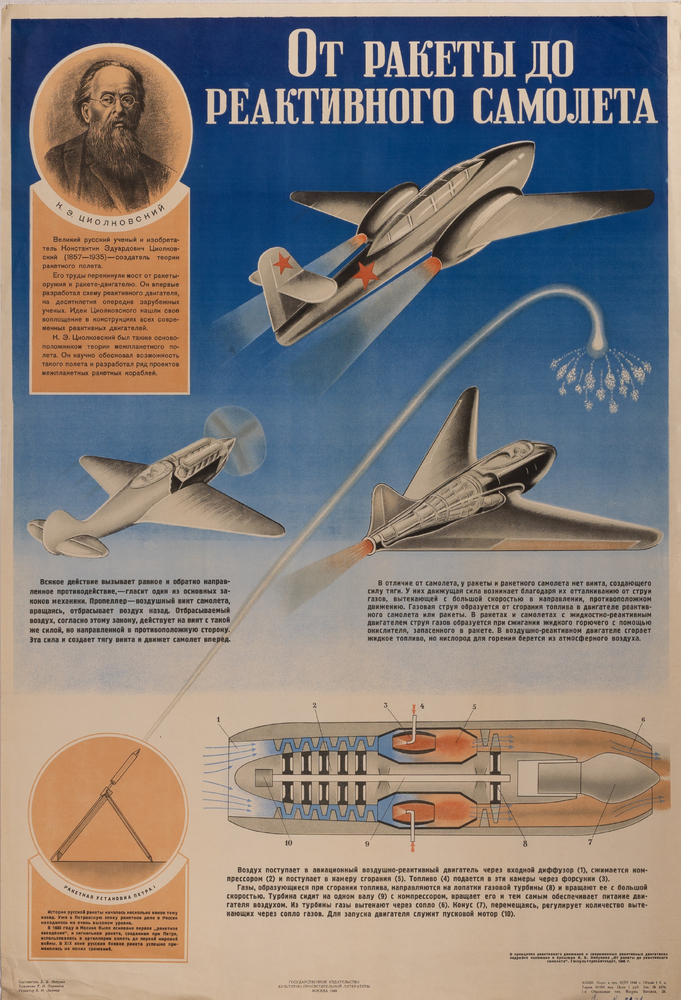
From rockets to jet aircraft (Russian)
Poster
This image is available only to signed-in users.
Protected by copyright. The poster images are published on the website for non-commercial purposes – for viewing, education and research.
- Identifier
- JS590
- Category
- P.10. Miscellaneous
- Subject
- P.10. Miscellaneous
- Shelve
- E.5.
- Title
-
en
From rockets to jet aircraft (Russian)
AI (Unreviewed)
Provenance Translated by mistral-large-latest on 23.04.2026 - No raķetes līdz reaktīvajām lidmašīnām (krievu val.)
- Year
- 1948
- Author
- J. I. Perņikov
- Publisher
- Valsts kultūras un izglītības izdevniecība
- Place
- Moscow
- Method
- unknown
- Dimensions
- 58,5 x 86 cm
- Preservation
- 9
- Print run
- 50,000
- Count
- 2
- Language
-
Russian
AI (Unreviewed)
Provenance Generated by mistral-large-latest on 23.07.2026
The poster is designed with a blue background and orange and white accents. In the upper right part, there is a large, bold inscription, below which a jet aircraft with a delta wing shape is depicted. In the upper left corner, there is an oval portrait of a man with a long beard and hair. Below the portrait and the aircraft image, there are several illustrations showing various aircraft models and technical diagrams. One of the diagrams depicts the wing profile of the aircraft, another—the internal structure of the jet engine with detailed explanatory elements. The poster uses various font types, including bold and standard fonts, as well as arrows and lines that connect individual images and explanatory diagrams. The colors are contrasting, mainly blue, orange, and gray tones.
AI (Unreviewed)
Provenance Generated by mistral-large-latest on 21.07.2026; Translated by mistral-large-latest on 22.07.2026
[?] ракеты до реактивного самолета
Великий русский ученый и изобретатель Константин Эдуардович Циолковский (1857—1935)—создатель теории ракетного полета.
Его труды перекинули мост от ракеты-оружия к ракете-двигателю. Он впервые разработал схему реактивного двигателя, на десятилетие опередив зарубежных ученых. Идеи Циолковского нашли свое воплощение в конструкциях всех современных реактивных двигателей.
Н. Э. Циолковский был также основоположником теории межпланетного полета. Он научно обосновал возможность такого полета и разработал ряд проектов межпланетных ракетных кораблей.
Всякое действие вызывает равное и обратно направленное противодействие,— [?] один из основных законов механики. Пропеллер—воздушный винт самолета, вращаясь, отбрасывает воздух назад. Отбрасываемый воздух, согласно этому закону, действует на винт с такой же силой, но направленной в противоположную сторону. Эта сила и создает тягу винта и движет самолет вперед.
В отличие от самолета, у ракеты и ракетного самолета нет винта, создающего силу тяги. У них движущая сила возникает благодаря их отталкиванию от струи газов, вытекающей с большой скоростью в направлении, противоположном движению. Газовая струя образуется от сгорания топлива в двигателе реактивного самолета или ракеты. В ракетах и самолетах с жидкостно-реактивным двигателем струи газов образуется при [?] жидкого горючего с помощью окислителя, запасенного в ракете. В воздушно-реактивном двигателе сгорает жидкое топливо, но кислород для горения берется из атмосферного воздуха.
История русской ракеты началась несколько веков тому назад. Уже в [?] ракетное дело в России [?] зрение.
В [?] году в Москве было основано первое „ракетное овладение“, [?] [?] ракете, созданное при Петре, [?] в [?] [?] до первой мировой войны. В [?] веке русские [?] ракеты успешно применялись [?]
Воздух поступает в авиационный воздушно-реактивный двигатель через входной диффузор (1), сжимается компрессором (2) и поступает в камеру сгорания (3). Топливо (4) подается в эти камеры через форсунки (3).
Газы, образующиеся при сгорании топлива, направляются на лопатки газовой турбины (6) и вращают ее с большой скоростью. Турбина сидит на одном валу (9) с компрессором, вращает его и тем самым обеспечивает питание двигателя воздухом. Из турбины газы вытекают через сопло (6). Ионус (7), перемещаясь, регулирует количество вытекающих через сопло газов. Для запуска двигателя служит пусковой мотор (10).
В [?] реактивного двигателя. Подробно [?] в [?] Н. [?] [?] «От ракеты до реактивного самолета». [?] г.
[?] (Иванов)
[?] Е. [?] [?]
ГОСУДАРСТВЕННОЕ [?]
[?] ИНТЕРАТУРЫ
МОСКВА [?]
[?] [?] г. [?] 1 п. л.
Тираж [?] 000 экз. [?] [?] зак. Зак. № [?]
[?] п. [?]
Великий русский ученый и изобретатель Константин Эдуардович Циолковский (1857—1935)—создатель теории ракетного полета.
Его труды перекинули мост от ракеты-оружия к ракете-двигателю. Он впервые разработал схему реактивного двигателя, на десятилетие опередив зарубежных ученых. Идеи Циолковского нашли свое воплощение в конструкциях всех современных реактивных двигателей.
Н. Э. Циолковский был также основоположником теории межпланетного полета. Он научно обосновал возможность такого полета и разработал ряд проектов межпланетных ракетных кораблей.
Всякое действие вызывает равное и обратно направленное противодействие,— [?] один из основных законов механики. Пропеллер—воздушный винт самолета, вращаясь, отбрасывает воздух назад. Отбрасываемый воздух, согласно этому закону, действует на винт с такой же силой, но направленной в противоположную сторону. Эта сила и создает тягу винта и движет самолет вперед.
В отличие от самолета, у ракеты и ракетного самолета нет винта, создающего силу тяги. У них движущая сила возникает благодаря их отталкиванию от струи газов, вытекающей с большой скоростью в направлении, противоположном движению. Газовая струя образуется от сгорания топлива в двигателе реактивного самолета или ракеты. В ракетах и самолетах с жидкостно-реактивным двигателем струи газов образуется при [?] жидкого горючего с помощью окислителя, запасенного в ракете. В воздушно-реактивном двигателе сгорает жидкое топливо, но кислород для горения берется из атмосферного воздуха.
История русской ракеты началась несколько веков тому назад. Уже в [?] ракетное дело в России [?] зрение.
В [?] году в Москве было основано первое „ракетное овладение“, [?] [?] ракете, созданное при Петре, [?] в [?] [?] до первой мировой войны. В [?] веке русские [?] ракеты успешно применялись [?]
Воздух поступает в авиационный воздушно-реактивный двигатель через входной диффузор (1), сжимается компрессором (2) и поступает в камеру сгорания (3). Топливо (4) подается в эти камеры через форсунки (3).
Газы, образующиеся при сгорании топлива, направляются на лопатки газовой турбины (6) и вращают ее с большой скоростью. Турбина сидит на одном валу (9) с компрессором, вращает его и тем самым обеспечивает питание двигателя воздухом. Из турбины газы вытекают через сопло (6). Ионус (7), перемещаясь, регулирует количество вытекающих через сопло газов. Для запуска двигателя служит пусковой мотор (10).
В [?] реактивного двигателя. Подробно [?] в [?] Н. [?] [?] «От ракеты до реактивного самолета». [?] г.
[?] (Иванов)
[?] Е. [?] [?]
ГОСУДАРСТВЕННОЕ [?]
[?] ИНТЕРАТУРЫ
МОСКВА [?]
[?] [?] г. [?] 1 п. л.
Тираж [?] 000 экз. [?] [?] зак. Зак. № [?]
[?] п. [?]
AI (Unreviewed)
Provenance Generated by mistral-ocr-latest on 23.07.2026
[?] from rockets to jet aircraft
The great Russian scientist and inventor Konstantin Eduardovich Tsiolkovsky (1857–1935) was the creator of the theory of rocket flight.
His works bridged the gap from the rocket as a weapon to the rocket as an engine. He was the first to develop a schematic of a jet engine, a decade ahead of foreign scientists. Tsiolkovsky's ideas found their embodiment in the designs of all modern jet engines.
N. E. Tsiolkovsky was also the founder of the theory of interplanetary flight. He scientifically substantiated the possibility of such a flight and developed a number of projects for interplanetary rocket ships.
Every action causes an equal and oppositely directed reaction—[?] one of the fundamental laws of mechanics. The propeller—the airplane's air screw—rotating, pushes air backward. The air being pushed, according to this law, acts on the screw with the same force but directed in the opposite direction. This force creates the thrust of the screw and moves the airplane forward.
Unlike an airplane, a rocket and a rocket-powered aircraft have no screw creating thrust. Their driving force arises due to their repulsion from the stream of gases flowing out at high speed in the direction opposite to the motion. The gas stream is formed by the combustion of fuel in the engine of a jet aircraft or rocket. In rockets and aircraft with liquid-propellant engines, the gas stream is formed by [?] liquid fuel with the help of an oxidizer stored in the rocket. In an air-breathing jet engine, liquid fuel burns, but the oxygen for combustion is taken from atmospheric air.
The history of the Russian rocket began several centuries ago. Already in [?], rocket science in Russia [?] attention.
In [?], the first "rocket establishment" was founded in Moscow, [?] [?] rocket, created under Peter, [?] in [?] [?] until the First World War. In the [?] century, Russian [?] rockets were successfully used [?].
Air enters the aviation air-breathing jet engine through the inlet diffuser (1), is compressed by the compressor (2), and enters the combustion chamber (3). Fuel (4) is supplied to these chambers through nozzles (3).
Gases formed during fuel combustion are directed onto the blades of the gas turbine (6) and rotate it at high speed. The turbine is mounted on the same shaft (9) as the compressor, rotates it, and thus ensures the engine's air supply. From the turbine, gases flow out through the nozzle (6). The cone (7), moving, regulates the amount of gases flowing out through the nozzle. A starter motor (10) is used to start the engine.
In [?] of the jet engine. Detailed [?] in [?] N. [?] [?] "From the Rocket to the Jet Aircraft." [?] year.
[?] (Ivanov)
[?] E. [?] [?]
STATE [?]
[?] OF LITERATURE
MOSCOW [?]
[?] [?] year. [?] 1 p. l.
Circulation [?] 000 copies. [?] [?] order. Order No. [?]
[?] p. [?]
The great Russian scientist and inventor Konstantin Eduardovich Tsiolkovsky (1857–1935) was the creator of the theory of rocket flight.
His works bridged the gap from the rocket as a weapon to the rocket as an engine. He was the first to develop a schematic of a jet engine, a decade ahead of foreign scientists. Tsiolkovsky's ideas found their embodiment in the designs of all modern jet engines.
N. E. Tsiolkovsky was also the founder of the theory of interplanetary flight. He scientifically substantiated the possibility of such a flight and developed a number of projects for interplanetary rocket ships.
Every action causes an equal and oppositely directed reaction—[?] one of the fundamental laws of mechanics. The propeller—the airplane's air screw—rotating, pushes air backward. The air being pushed, according to this law, acts on the screw with the same force but directed in the opposite direction. This force creates the thrust of the screw and moves the airplane forward.
Unlike an airplane, a rocket and a rocket-powered aircraft have no screw creating thrust. Their driving force arises due to their repulsion from the stream of gases flowing out at high speed in the direction opposite to the motion. The gas stream is formed by the combustion of fuel in the engine of a jet aircraft or rocket. In rockets and aircraft with liquid-propellant engines, the gas stream is formed by [?] liquid fuel with the help of an oxidizer stored in the rocket. In an air-breathing jet engine, liquid fuel burns, but the oxygen for combustion is taken from atmospheric air.
The history of the Russian rocket began several centuries ago. Already in [?], rocket science in Russia [?] attention.
In [?], the first "rocket establishment" was founded in Moscow, [?] [?] rocket, created under Peter, [?] in [?] [?] until the First World War. In the [?] century, Russian [?] rockets were successfully used [?].
Air enters the aviation air-breathing jet engine through the inlet diffuser (1), is compressed by the compressor (2), and enters the combustion chamber (3). Fuel (4) is supplied to these chambers through nozzles (3).
Gases formed during fuel combustion are directed onto the blades of the gas turbine (6) and rotate it at high speed. The turbine is mounted on the same shaft (9) as the compressor, rotates it, and thus ensures the engine's air supply. From the turbine, gases flow out through the nozzle (6). The cone (7), moving, regulates the amount of gases flowing out through the nozzle. A starter motor (10) is used to start the engine.
In [?] of the jet engine. Detailed [?] in [?] N. [?] [?] "From the Rocket to the Jet Aircraft." [?] year.
[?] (Ivanov)
[?] E. [?] [?]
STATE [?]
[?] OF LITERATURE
MOSCOW [?]
[?] [?] year. [?] 1 p. l.
Circulation [?] 000 copies. [?] [?] order. Order No. [?]
[?] p. [?]